Tuesday, September 16, 2014

Louise Nevelson: Shape, Color and the Universe


Growing up, I was a HUGE fan of coloring. Give me a coloring book and a box of crayons and I was a happy camper. Not only was the act of coloring enjoyable, but reading all the names of each crayon was a treat. Sometimes a bit over my head, or extremely familiar like Tickle-Me-Pink and Macaroni and Cheese. Even today I enjoy the occasional coloring book with all my favorite colors. Although most of my interests have remained the same, I now analyze that box of crayons, looking and using colors that weren't of interest to me growing up. One such color I have rediscovered is black. A useful and multifunctional color, but one used more for necessity and not for pleasure. Now, as an adult my entire viewpoint on the color black has changed. I now view this color as elegant, refined and the epitome of classic.

An artist who perfectly captures this respect and admiration for this sophisticated color is Louise Nevelson. Not only did she favor black, but her work focused on the element of Shape, a nice follow up to my previous post on the work of Frank Stella.

"I create my own universe with shape."


Her story has always fascinated me. Born in Russia, her family moved to Rockland, Maine at the age of 5. After her marriage, she found her way to New York City. Nevelson was a wife, a mother and an artist. When forced to choose what to devote her time to, the role of artist won. She embodied the fierce spirit of a woman on a mission. The choice to be an artist and not a stay at home mother was personal. I am neither praising nor judging Nevelson for her actions, but admiring her determination. After a period studying art, having very little money, selling little to nothing, she finally had her first show in 1941. Trial and error, plus another two decades would lead to the breakthrough that is characteristic of the style we know and love.

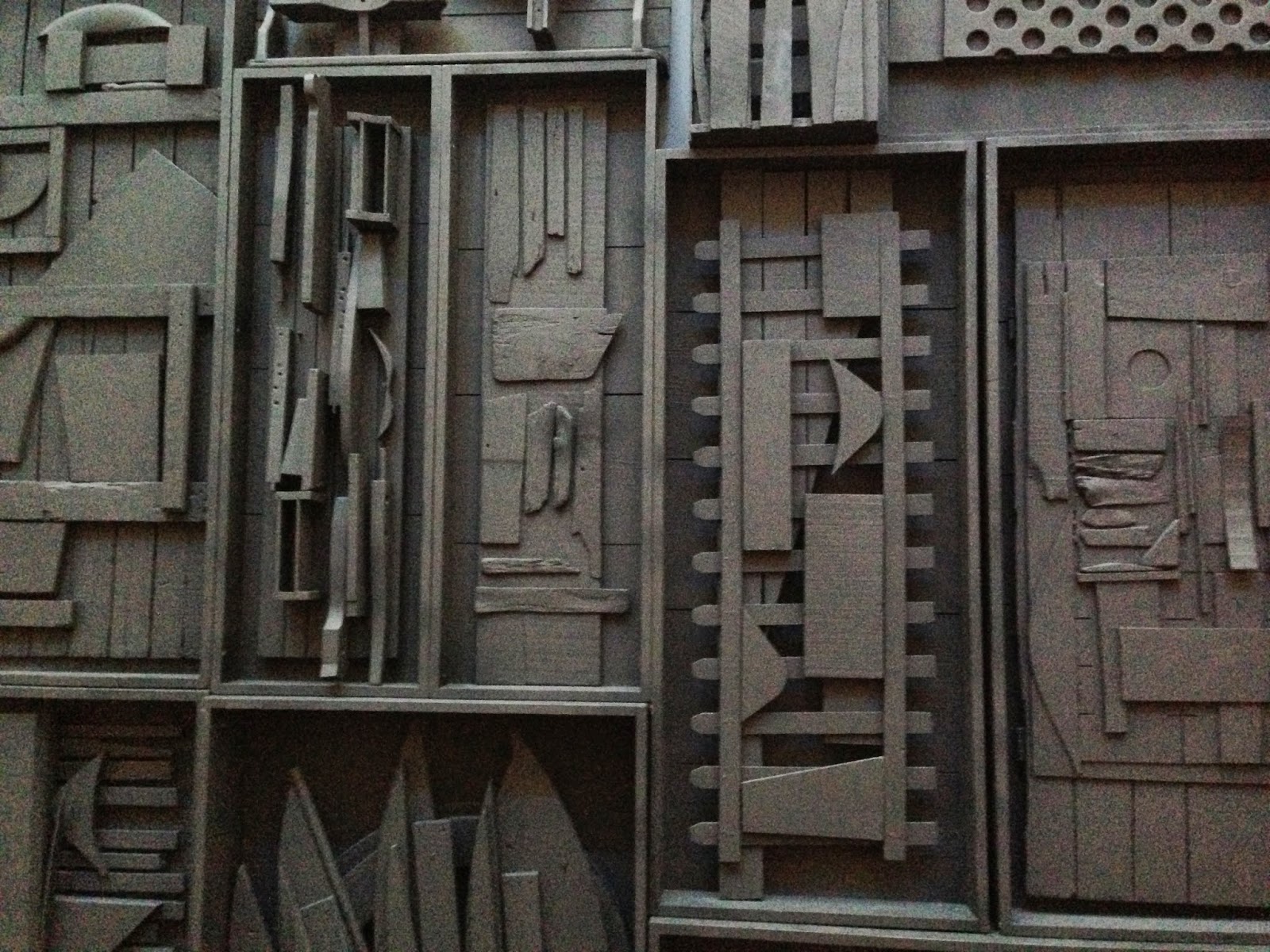
Nevelson, was up-cycling and reusing materials well before the curve. She would pick up wooden pieces from the side of the road, broken disregarded objects would become beautiful works of art in her skilled hands. She would assemble such pieces in sections, or individual boxes, and then combine these units together. What is so unique about her work, is the combination of several sculptures working together to create one overall environment. Nevelson is labeled as a sculptor, but her work is so much more than a static three dimensional object. As she said, "I create places not sculptures." I couldn't agree more. Her work transports you through your own imagination. You recognize objects and make others up all in the same breathe. It's impossible to be bored when faced with a Nevelson installation.  Just like her work, she was a character. With her layers of fake eyelashes, head scarves and shawls, she demanded attention.


In her work, she favored three main colors: white, gold and of course black. Each piece would be made up of smaller objects, but in the end everything would be painted a solid color. This way the viewer doesn't not focus on the function of one element, but on the work as a whole. The color unifies and presents a new opportunity to us as the viewer. To Nevelson black was aristocratic, weight less and most of all, containing all colors. This is exactly my feeling towards this often over looked crayon in my box. Her pieces are magical and inviting. When I stand in front of her work, I can imagine my favorite story coming to life, like I've become Alice, about to step into my own Wonderland. Lucky for me and you her work is very collectible. In Ohio alone, three premier institutions have pieces including: The Toledo Museum of Art, The Columbus Museum of Art, and The Dayton Art Institute.

From The Toledo Museum of Art:

Louise Nevelson, Sky Presence 1, 1961, Wood & Black Paint.
Detail from Sky Presence 1


From The Dayton Art Institute:

Louise Nevelson, Untitled, 1985, Wood & Black Paint.


Detail from Untitled 
 Each is one work of art composed of hundreds of other objects. Once a table leg, a railing, or a crate that outlived its purpose, it is transformed into a monumental and permanent work of art. What objects can you identify? Which are familiar to you and why? Did you ever view them as works of art before?

 In addition to being painted one color, Nevelson often worked in series, naming each piece for what it represented in the collection. Her motif: everyday objects re-purposed. Notice in the details that she did not altar the pieces that she found. If there was damage, nails or holes she let them show. Even art can be rough around the edges. She showed us beauty in the ordinary, that natural is more fulfilling than a fake veneer of beauty. 

Talk about seeing the beauty in every day objects. Look around you, can you view your common, ordinary objects in a new light? Imagine unifying objects with color. Which color best represents you and why? Has this changed throughout your life? If everything is the same color what happens is the focus is not on the purpose or use of the object, but its form and shape, finally it gets to be appreciated for being itself and not for its usefulness. Louise Nevelson was more than a sculptor, she was a creator. What beauty can you create today?                                                           
                                                                                                                                                 ~Samantha

Monday, September 8, 2014

Artist Highlight: Rineke Dijkstra

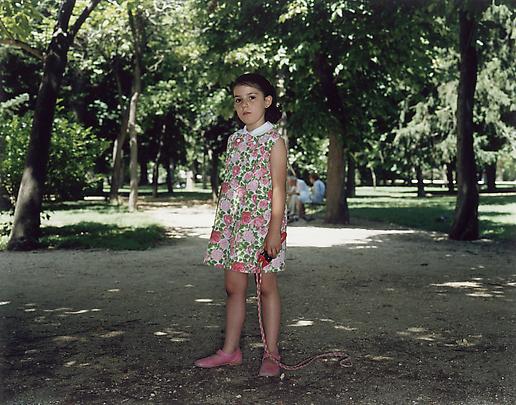
Beach Portraits, 1992
The work of Rineke Dijkstra, a Dutch artist who utilizes photography as a vehicle to create compelling portraits, has always fascinated me. When we think of portraits, generally a picture of a person looking at us, smiling, and seemingly happy comes to mind. Or perhaps, the generic grade school photos are more prominent. Whatever the case may be, having a picture taken of you always leads to a pose, smiling, and saying cheese. Dijkstra's photographs don't fit that description. In a way, they take a step further and show a true likeness of the individual she captures in her lens, rather than the facade that can be created by the 'cheese' effect. She typically chooses young adolescents or young adults as her subject matter, perhaps because they are the ones still constructing their identities, making the likeness all the more challenging to capture. And sometimes her choice of subject matter may be what what makes her photographs so enticing, moments in time with awkward youths, new mothers after birth, and intrusions in the park all give the viewer a feeling that they are an interloper into the private space of the subject.

Her most striking portraits were produced when she photographed women after having just given birth. Standing against a backdrop of stark white hospital walls, the viewer is presented with a new mother and her infant, still nude and not yet sure of the role that she has just taken on. A woman in a liminal space, one identity has been left behind and one is before her waiting to be donned. What strikes me the most is the contrast these photographs offer between what we all imagine those first moments between mother and child to be, and the reality of what they are. The surroundings that are utilized in all of Dijkstra's work emphasize the connection, or lack-thereof, of the subject with the photographer and the silent conversation between the two that may or may not be taking place. 

                              
To me, Dijkstra's portraits are all about the self, identity and the liminal space where they meet and are performed. We constantly are changing, whether in the roles we choose to play  or those that or forced upon us. And in a world where so much of who we are and how we depict that is created through our own choice, these photographs depict individuals at moments in time that seem private or unexpected, allowing the viewer to witness a sense of confrontational self-consciousness, if you will. 

So what do you think? Do her photographs allow for insights never seen before? Do they make you uncomfortable? Do you consider her photographs portraits? 

Thursday, August 28, 2014

The Shapes of Frank Stella

As an art history teacher, I believe it is important to have a solid understanding of the art vocabulary. Not only will art history lectures and text books finally become clear (I hope), but you are better able to articulate what's in your head.

My word for the week is SHAPE or an enclosed area. We have such a variety of shapes to choose from such as: rectangles, circles, squares, triangles, geometric vs. organic, etc. These enclosed areas are often secondary, maybe in the background, and are rarely the focal point of an artwork. 

Today, I'm highlighting an artist who focuses on shape and shape alone. Not only are shapes the most important aspect of his paintings, they are the painting. Who other than Frank Stella. The man who literally thought outside the box, or in this case the canvas. Tradition is comforting, it is familiar, however, it is not the only way. Rectangular canvases...or is there something more? Stella is most known for his unusually shaped canvases. Here we are presented with a triangular shaped canvas, featuring 3 colors: yellow, pink and tan. The pink triangle is overlapped with a bright yellow square with a line extending to the left. 


Frank Stella, Union 1, 1966. Paint on canvas. 
The tan acts as a border framing the pink and yellow shapes. A great example of an overall composition, the backgroundmiddle ground and foreground become one. Our subject matter consists of shapes and colors nothing more and nothing less. Stella has been labeled as a Minimalist. A style that used industrial materials, neutral color schemes, focused on form, precision and strove to communicate ideas in a new fashion. 

To be honest, this is not my favorite type of art. Most Minimalist artworks seem very cold and formal to me. I dislike the bland colors and feel the simple compositions are not challenging or very enjoyable to look at. That is until I encountered the work of this artist. Who knew simplicity could be beautiful? There is no confusion here, as Stella said, "What you see is what you get." How perfect. He is direct and to the point. 

Look, see, and understand. Art is not always complicated. Simple yes, refreshing defiantly. Stella proves there are still uncharted frontiers in the art world. Manipulating the platform in which the art is presented, he made the canvas apart of the composition instead of merely being a support or backdrop. This treatment has finally brought shape into the limelight. Although this is a standard rectangle, the painting below also glorifies shape and uses color to help distinguish each curve and circle. A solid background pushes our arrangement of intersecting shapes forward. The clean lines makes this feel finished and neat. The surface treatment, and the attention to detail makes Stella a Minimalist. His treatment of boundaries and experimentation in color make him a Modernist. 

Frank Stella, Lac Laronge IV, 1969. Acrylic on canvas.

At first glance these paintings might seem unextraordinary.  Challenge yourself to look closer and to interpret what this new idea could mean. Is Stella challenging the status quo? Is this a statement? Or maybe it is purely for aesthetic purposes? Debate the significance of tradition. What are the pros and cons? Should there be more or less experimentation in the art world? Such questions keep the debate alive, forever adding to the canon of art history. Again, "What you see is what you see," And what is it that you see?
                                                                                                                                     
                                                                                                                                              ~Samantha 


Monday, August 25, 2014

The Museum Experience


What makes a good experience in a museum? Is it seeing a special exhibit that you've been planning to see for weeks in advance? Is it seeing something unexpected or new? Or is it viewing the work of an artist you have studied before and you become reacquainted with an old friend? I had the opportunity to visit two, yes TWO art museums in one weekend, and let me tell you, each experience was unique in many ways- so I thought why not pass along what insights I've gained into the making of a great experience in an art museum. 

Flint Institute of Arts:
 Me under/in an old Medieval/Renaissance Fireplace
Have fun with your visit, document when possible!
Examine works closely, consider all angles!
          The two museums that I visited with some friends were the Flint Institute of the Arts and the Detroit Institute of Art. They are very different in size, as one is a university museum and the other is a large city institution, so the number of visitors each had also differed, I'm sure you can guess which had more! I did go with two friends who are also art obsessed, which helped to create positive engaging visits since we could bounce feelings, thoughts, and questions off one another. One thing I did very little of before my visits was research on the collections/exhibitions. Sometimes I make a museum visit because of a particular show that they have or because I know they have certain objects in their collection, but in this case my visit was decided because I was in the area and it was a convenient weekend to go. 

Museum Selfies are important!
In my time as a museum go-er, there are a few things you must consider as you begin your visit. Do you have to do every single suggestion on the list, no. But you owe it to yourself to participate in your visit, it is the only way you can 'get' anything out of your visit. What if you don't want to get anything out of the visit, what if you just want to look, walk and enjoy the environment? Well you can do that too, but at least consider these tips for having a fun day at the art museum! DISCLAIMER: Everyone is an individual and therefore their experience depends on their own likes and dislikes. I happen to love going to museums, art or otherwise, so my experience is unique and yours will be too!

1. What is your limit? In other words, know how long it takes before you reach the point where you can't stand another minute or you need to put food in your tummy. Also, consider whether you will dine in the museum at their cafe or if you have to find food once you leave. This always drastically effects my experience in the galleries.

2. Talk to the people you are going with, find out what they want to see, what you want to see and what you both can do without to maximize your experience without minimizing your enjoyment.

3. Ask questions! Whether you are in conversation with yourself, a gallery guard, or your friend- talk about what you are seeing. Figure out why you like it or don't like it! Don't just walk by say eh and be done with it.

4. Look. This takes more than 3 seconds. Let your eye glide over the work of art, consider the text that is written if you like, look at the fine details. Examine all possible views or angles! In other words, really see the work of art rather than just notice it and continue walking.

5. If you enjoy a work of art- get excited by it! If it is something you are surprised to see or find it particularly pleasing to the eye- let someone know. Appreciating art and having an experience with it doesn't have to be an internal process that you keep to yourself. One of the most contagious things in an art museum is people getting excited about art!

6. Take notes! If there is a piece that has you intrigue and you want to know more, write down the title and name of the artist. Your learning doesn't have to end when you leave the museum, find out more when you go home.
Expect the unexpected!
Get excited when you see something cool!

Art Appreciation at its finest!
Become an artist yourself!
 If photos are allowed, take them-
they will create lasting memories!


Go with friends who challenge you and your views on art-
it will be highly rewarding!
The experience you may have in a museum is one that has been thought out, planned, and hoped for by many museum professionals, but the experience only exists once you take part. So, within this post are some helpful hints, tips, and examples of how to make the most out of your trip to an art museum. Take them or leave them, but know this,  these museums I visited were very different in size, type of collection, location, etcetera, and the experience I had in each was very different, but in the end they were exciting, fulfilling and inspiring visits. Does this happen for me every time I visit an art museum? No. But do I leave seeing the world a little bit differently than I did before? Sure. I leave with more knowledge, more curiosity, and a greater sense of where I stand in the world I live in.  Seems like no matter what, I get out of a visit what I put into it.

Ahh Monet, how I love thee! So far I have seen 38!

Wednesday, August 13, 2014

Art Appreciation 101

My belief is that anyone can appreciate art. To me it doesn't matter if you have mastered stick people or make 8 foot oil portraits. Nor does your profession, age, or education level keep you from developing this skill.

Over the years several people have asked me, "Why do you like art history?" (Most of these being students.) Art Appreciation is a great class to teach, it gives me the opportunity to show my students why out of all my choices, I choose to specialize in art history. You might wonder what I tell my students, it goes a little something like this:

I like art history because it's subjective. Everyone can have a different opinion and that's ok! I strongly encourage opinions, the more the merrier. Textbooks are vast wells of knowledge, nonetheless they do not poses the only interpretations.

Then I give an example to help illustrate my point: Math has always been a difficult subject for me. Having those basic skills like adding in your head, knowing how to move decimal points and long division all prove important for daily life. However, I always felt that math put me in a box, right or wrong, answer or no answer, understanding or confusion.

Art history is no cake walk, but it is more than reaching the right conclusion or plugging numbers into a formula. The history is just as important as the art. Knowing the facts behind the artist's motivation are as significant as analyzing the colors used. Context, the social climate, the economy, the artist's background are all aspects to be studied in addition to the formal analysis of the piece.

I do not expect my students to fall madly in love with art after taking my class. Not only is that totally unrealistic, it's the opposite of my goal. I want students to be more open to artwork. I want them to look at a work of art, to discover what draws them in or why they dislike it. To instead of glancing and deciding they have no interest, to instead take 30 seconds and give it a second look. Then reading the wall text for further information, and you guessed it, to look once more.

This clip summarizes my teaching philosophy towards art appreciation and by extension art history.

https://www.youtube.com/watch?v=aHCUoDf7KGA

Do me a favor, watch this video.                                                                                            ~Samantha

Friday, August 1, 2014

A Little Art with your Hotel?

How would you like to stay in a place where each room is a little different? Gone are the generic prints or canvases framed on the walls in each and every room, and environments that are interchangeable, you could be in Columbus or Chicago but you wouldn't know the difference just looking at the walls in your hotel. At 21c Museum Hotels, a new brand of boutique lodging, you not only have a comfortable room in a prime location, but the unique experience where museum and hotel merge into one.
21c Museum Hotel Cincinnati
(image credited to http://media-cdn.tripadvisor.com)
I recently had the pleasure of visiting one of the 21c Museum Hotels in Cincinnati, not as a guest, but as a visitor to the museum, which is open to the public.  It's in the perfect location, right next to the Contemporary Arts Center and across the street from the Arnoff Center. The museum is made up of two floors of gallery space that is filled with ever-changing exhibitions. I was pleasantly surprised to find a mix of artists I recognized and some I didn't, art I liked and some I didn't. Their current exhibition is entitled Hybridity: The New Frontier, which explores the evolution of species and spaces. There are also a number of works that are apart of the Museum's permanent collection. Currently, there are three locations for these fabulous accommodations: Cincinnati, Louisville, and Bentonville, with more locations opening up across the south. 

Some may say that it will never last or its simply the new 'next best thing', but looking a little deeper at the company one finds at its heart good intentions that are being realized. Its founders are trying "to create both an economic driver for the community and an oasis where art challenges and amuses, stimulates conversation and provokes new ideas." They are promoting contemporary 21st century artists in a venue that embodies the century it was created in. So many places, small town and large city alike, are attempting to reinvigorate their downtown areas and with lodgings like this, it becomes a destination all on its own. So next time you are in Cincinnati, Louisville, or Bentonville and you are looking for a place to stay or a small museum to visit, check out 21c for an inspiring experience. 

~Caitlin 

First Post: Inspiration


"Inspiration exists, but it has to find you working."~ Pablo Picasso.

          Inspiration exists....an interesting thought to ponder. Often, we view that the other way around, that we must constantly seek inspiration, almost having to create it ourselves. Instead, Picasso offers us a new solution. Inspiration is a gift, nay a reward for the determined. Those who work hard will be rewarded with a never ending supply of ideas and simulation. This coming from a man who hated working from life and preferred instead to let his imagination run wild. I personally find it refreshing. What is so unique about artists that they seem to never run out of stimulation? Why do they have this ability? Could it be as simple as taking the time to look...? Yes, I believe it is. Everyone can be an artist. Everyone can be and is creative. Just like art has no set media or parameters, the same applies to the driving force behind it, not to mention the end product. Inspiration is attainable for all who seek it. The act of seeking is all that is required. ~Samantha